
LIFE BEYOND FIRST CLASS


DESIGN & ARCHITECTURE
THE LIVING CHÂTEAU
At Château La Banquière, Marianne Tiegen Interiors transforms an 18th-century estate into a quietly luxurious hospitality retreat where textiles, light, and landscape shape a deeply sensorial and sustainable experience.
JESSICA HALL
PHOTOGRAPHY: JEREMY WILSON


For more than two decades, Marianne Tiegen Interiors has cultivated a distinct design language rooted in emotion, material intelligence, and an unwavering respect for place. With studios in Switzerland, France, and California, the firm approaches each project, residential or hospitality, as an opportunity to create spaces that feel deeply lived-in rather than simply designed. Founder Marianne Tiegen is known for her intuitive understanding of how interiors shape experience, blending art, nature, and craftsmanship to produce environments that resonate on a human level.
That philosophy finds a particularly poetic expression at Château La Banquière, an 18th-century estate nestled among vineyards and centuries-old oak trees near Montpellier. Reimagined as a hospitality destination, the château has been transformed not through excess, but through restraint, light, and an extraordinary devotion to craft. Here, architecture, landscape, and textiles exist in quiet conversation, offering a contemporary vision of sustainable luxury that feels both timeless and intimate.


From the moment one enters the estate, the surrounding landscape asserts itself. Ancient oaks cast dappled shadows across stone façades, while the vineyards stretch outward in rhythmic calm. The design responds by amplifying this dialogue with nature. Each room is conceived as a vessel for light, air, and material, where stone, wood, and textile surfaces shift gently throughout the day. Interiors breathe, never overpowering the château’s classical bones, but softening them, allowing history to remain present without feeling preserved.
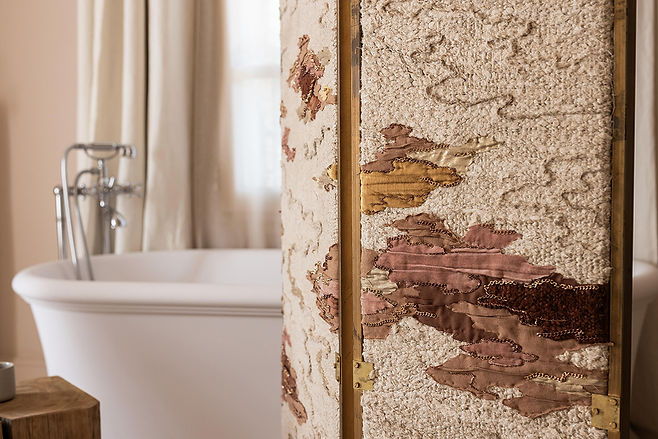
Textiles play a central role in this transformation. At La Banquière, they are not decorative afterthoughts, but spatial anchors. Canopies, screens, bed throws, and wall panels define rooms, modulate acoustics, and frame views, introducing a sense of domestic warmth more often associated with private homes than hospitality environments. Their presence brings intimacy to scale, allowing guests to feel cocooned rather than accommodated.

The textile palette draws deeply from the château’s Mediterranean context. Working alongside botanical dyers and local artisans, Marianne Tiegen Interiors developed a series of custom hues derived directly from the land itself. Soft blush tones are created from grape seeds harvested on the estate, while warm coral and apricot shades emerge from garance, or madder root. These are layered with gentle blues and greys from pastel, or woad, echoing sky, stone, and shadow. The result is a chromatic language that feels quietly romantic, subtly sun-warmed, and intrinsically tied to place.
Antique textiles further enrich the narrative. Provençal damasks, Venetian block prints, and couture-surplus fabrics sourced through long-standing relationships with collectors and dealers appear throughout the rooms. In some spaces, a single antique textile served as the genesis of the entire design scheme, its patina, irregularity, or faded pattern setting the tone. Where age rendered fabrics fragile, they were restored, reinforced, or respectfully repaired, their imperfections embraced rather than concealed, akin to a textile-bound form of kintsugi.


Artisan craftsmanship extends beyond fabric. Belgian woven linens, hand-printed serigraphies from historic Lyon workshops, and Venetian block printing are paired with embroidered panels employing haute couture techniques. A recurring bee motif, stitched using the Pont de Beauvais technique, quietly references the estate’s biodiversity and regenerative ethos, reinforcing a circular design philosophy that values longevity over novelty.
Practicality is woven into the beauty. Canopies and screens are designed to be removed, cleaned, repaired, or re-dyed over time. Upholstery features removable covers, and textile-clad panels are intended to evolve, ensuring the château can age gracefully, growing richer rather than worn.

For Marianne Tiegen, Château La Banquière stands as a manifesto. Sustainable hospitality, she believes, is not about restraint for its own sake, but about choosing materials and methods that carry memory, dignity, and care. In time, the fabrics of La Banquière will tell their own story, one of patience, place, and a luxury defined not by excess, but by meaning.

Join our mailing list to receive curated updates, special features, and invitations to events that define the world of the discerning few.
Sign up today and never miss what’s next.