
LIFE BEYOND FIRST CLASS


ARTS & COLLECTIBLES
RAPHAEL:
SUBLIME POETRY
A once-in-a-generation exhibition that stripped away the myth of perfection to reveal Raphael as a restless, searching mind, making this not just a viewing, but an encounter with the very construction of genius.
KENDRA LOCK
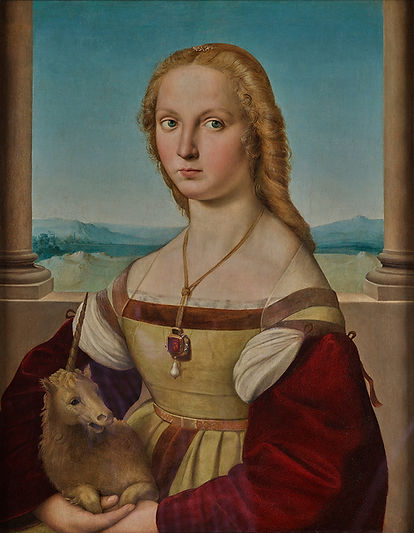
Raphael (Raffaello di Giovanni Santi) (Italian, 1483–1520), Portrait of a Lady with a Unicorn, 1505-6, Oil on canvas, transferred from wood, Galleria Borghese, Rome (371), Image
© Galleria Borghese, photo by Mauro Coen
Raphael, born Raffaello Santi in Urbino in 1483, remained one of the rare figures in art history whose name came to signify not simply mastery, but an ideal. The son of a court painter and poet, he was shaped early by an environment where visual intelligence and literary refinement were inseparable. By his early twenties, he had absorbed the lessons of Perugino, encountered the radical innovations of Leonardo da Vinci and Michelangelo, and translated them into a language distinctly his own. By the time he arrived in Rome in 1508, he was not merely participating in the Renaissance. He was defining it.
His career, though brief, unfolded with astonishing velocity. In less than four decades, Raphael moved from provincial commissions to the center of papal power, becoming the favored artist of Julius II and Leo X. He operated simultaneously as painter, architect, and designer, overseeing vast workshop productions while refining a vision rooted in clarity, balance, and human presence. Even among his contemporaries, his achievement was singular. Where Michelangelo pursued tension and Leonardo pursued mystery, Raphael pursued harmony, not as a simplification, but as a discipline.
What became clear in Raphael: Sublime Poetry at The Metropolitan Museum of Art was that this harmony was not innate. It was constructed.
Bringing together more than 200 works from major institutions and private collections worldwide, this landmark exhibition represented the first comprehensive international loan show dedicated to Raphael in the United States. It was presented with the support of Morgan Stanley, with major funding provided by Kenneth C. Griffin and Griffin Catalyst, alongside Jessie and Charles Price, among other significant donors whose contributions underscored the cultural weight of this undertaking. As Max Hollein noted, “This unprecedented exhibition will offer a groundbreaking look at the brilliance and legacy of Raphael, a true titan of the Italian Renaissance.”
The exhibition’s most consequential gesture lay in its emphasis on process. It dismantled the long-held myth of effortless perfection and replaced it with something far more compelling: a mind in constant negotiation with itself. Carmen Bambach, who curated the exhibition, reflected on this recalibration: “It is a thrilling opportunity to engage with his unique artistic personality through the visual power, intellectual depth, and tenderness of his imagery.”


Raphael (Raffaello di Giovanni Santi) (Italian, 1483–1520), Portrait of Baldassarre Castiglione 1514-1516, Oil on canvas, Musée du Louvre, Paris, département des Peintures (611 [MR 437]), Image © RMN-Grand Palais / Art Resource, NY
Raphael (Raffaello di Giovanni Santi) (Italian, 1483–1520), The Ecstasy of Saint Cecilia with Saints Paul, John the Evangelist, Augustine, and Mary Magdalene, ca. 1515-16, Oil on canvas (transferred from wood), Polo Museale dell’Emilia Romagna, Pinacoteca Nazionale, Bologna (577) Image: Scala / Art Resource, NY
Raphael’s drawings were not ancillary. They were the architecture of his thought. In them, one saw the repetition of forms, the recalibration of gesture, the incremental sharpening of composition. Figures were tested, abandoned, and reconfigured. Drapery folds were studied with near-scientific attention. Entire narratives were built, dismantled, and rebuilt. What appeared in the finished painting as inevitability was, in fact, the result of relentless iteration. Bambach underscored this prolonged engagement, describing the exhibition as “an extraordinary chance to reframe my understanding of this monumental artist.”
This was where the exhibition quietly shifted the stakes. By placing preparatory studies alongside finished works, it reframed Raphael not as a painter of resolved images, but as a strategist of visual intelligence. His compositions, whether in a Madonna or a Vatican fresco, were not simply balanced. They were engineered to feel inevitable.
Equally striking was the exhibition’s attention to Raphael’s emotional range. His Madonna and Child compositions, often reduced to symbols of serenity, revealed a more complex ambition. These were not distant divine figures. They were humanized presences, rendered with a sensitivity that bordered on psychological portraiture. His portraits, most notably that of Baldassarre Castiglione, achieved a rare equilibrium between presence and restraint, where the sitter appeared both fully known and quietly withheld. As the exhibition suggested, Raphael’s imagery carried both “intellectual heft and emotional depth,” a duality that continued to define his relevance.
_ca%201519-20_.jpg)
Raphael (Raffaello di Giovanni Santi) (Italian, 1483–1520),The Head and Hands of Two Apostles (“Auxiliary Cartoon” for the Transfiguration), ca. 1519- 20, Black chalk, traces of white gouache highlights, drawn freehand over pounce marks (spolvero underdrawing) on laid paper, Ashmolean Museum, Oxford, Presented by a Body of Subscribers in 1846 (WA1846.209),
Image © Ashmolean Museum, University of Oxford

Raphael (Raffaello di Giovanni Santi) (Italian, 1483–1520), The Annunciation (Cartoon for the Left Scene in the Predella of the Oddi Altarpiece), ca. 1503-4, Musée du Louvre, Département des Arts Graphiques, Paris (3860)
Photo credit: © RMN-Grand Palais / Art Resource, NY, photo by Michel Urtado;
_ca_%201.jpg)
Jan van Tieghem, Flemish (active ca. 1535–after 1573), Frans Gheteels, (act. 1540-68), after Raphael (Raffaello di Giovanni Santi) (Italian, 1483–1520), Christ’s Charge to Peter (from the Second Edition of the Acts of the Apostles Tapetry Series), Late 1540s or early 1550s, Wap: wool, 7-8 per cm; weft: wool and silk, lined on the reverse, 34-38 per cm, 16 ft. 15/16 in. × 23 ft. 10 1/4 in. (490 × 727 cm), Patrimonio Nacional, Colecciones Reales, Madrid, Spain, (10004081 (TA-12/2)), Courtesy of Patrimonio Nacional
This duality extended into his later works, where color deepened, compositions tightened, and a subtle dramatic tension began to surface. Influenced by Leonardo’s chiaroscuro and Michelangelo’s sculptural force, Raphael did not imitate. He absorbed and recalibrated. The result was a late style that felt denser, more charged, yet still governed by an internal order.
The significance of this exhibition lay precisely here. It did not present Raphael as a fixed point in history, but as an evolving intelligence. By tracing his development from Urbino to Florence to Rome, it revealed a practice defined not by consistency, but by adaptation.
In a contemporary context, this felt unexpectedly urgent. At a moment when visual culture often prioritized immediacy, Raphael’s work insisted on duration. It asked the viewer to slow down, to follow the line back to its origin, to consider the decisions embedded within each form. The exhibition resisted spectacle in favor of accumulation. Its impact was not immediate. It built.
For collectors and connoisseurs, this was where its value sharpened. To engage with Raphael was not to encounter a singular masterpiece, but to enter a continuum of thought. The drawings, in particular, offered a rare proximity to the artist’s process, a closeness that felt almost contemporary in its transparency. They revealed not perfection, but pursuit.
Ultimately, Raphael: Sublime Poetry did something quietly radical. It removed the distance that history had placed between the viewer and the artist. What remained was not the myth of genius, but the evidence of it.

Join our mailing list to receive curated updates, special features, and invitations to events that define the world of the discerning few.
Sign up today and never miss what’s next.