
LIFE BEYOND FIRST CLASS


ARTS & COLLECTIBLES
EMOTIONAL
GRAVITY
There are artists who construct objects, and there are artists who construct emotional climates. Petah Coyne belongs firmly to the latter.
REGINA RUSSO
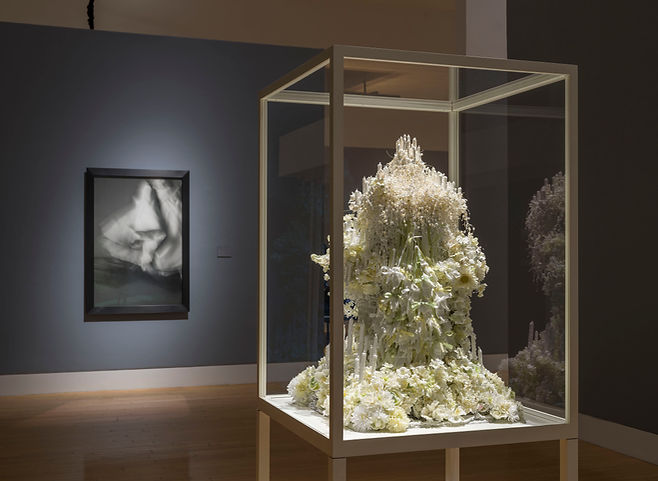
For more than four decades, the New York–based sculptor, Petah Coyne, has transformed the language of materials into something operatic, lush, devotional, and psychologically charged. Her work is not merely assembled; it is wrestled into being. Trees, wax, silk flowers, black sand, chandeliers, taxidermy, hospital bandages, scrap metal, human hair—Coyne’s material vocabulary reads like a catalog of fragility and ruin. In her hands, the discarded becomes transcendent.
Her sculptures often hang from ceilings or expand across floors in baroque formations that feel both sacred and destabilizing. Monumental yet intimate, they possess a tension that hovers between seduction and restraint. The viewer is drawn close only to discover that beauty here is edged with unease.
Coyne’s practice is deeply intuitive. She does not begin with formal plans or preparatory drawings. Instead, she allows emotion to dictate structure, trusting instinct over architecture. Literature, art history, film, and biography, particularly the lives of underrecognized women writers and cultural figures, serve as emotional catalysts. Zelda Fitzgerald, Joan Didion, Zora Neale Hurston, Jane Austen: these women are not simply referenced; they are reimagined in sculptural form.
Her work resides in the permanent collections of the Museum of Modern Art, the Metropolitan Museum of Art, the Guggenheim Museum, and the Whitney Museum of American Art, among others. Over the course of her career, she has mounted more than forty-five solo museum exhibitions and received numerous prestigious honors, including the Lifetime Achievement Award from the International Sculpture Center in 2024. Yet accolades feel secondary. What defines Coyne is not recognition but endurance.


That endurance is palpable in her recent exhibition, How Much a Heart Can Hold, presented at the Lowe Art Museum at the University of Miami. More than a survey, the exhibition unfolds as an immersive meditation on female identity, creative resilience, and transformation.
The title, drawn from a line by Zelda Fitzgerald, “Nobody has ever measured, even the poets, how much a heart can hold”, sets the emotional register. At the center of the exhibition stands Zelda, a seven-foot-tall sculptural monument constructed from an astonishing range of materials. Encased within a transparent vitrine, the work evokes both reverence and captivity. The glass enclosure reads as metaphor, a visible cage referencing Fitzgerald’s constrained legacy, her brilliance eclipsed by history and marriage. Coyne does not illustrate biography; she sculpts its emotional residue.


The exhibition is organized around three thematic pillars: Women’s Work, Women Obscured and Transformed, and Women’s Relationships. Each reinforces Coyne’s lifelong engagement with honoring female creativity while confronting its suppression. These works are not polite tributes. They are acts of reclamation rendered in velvet, steel, wax, and ash.
One of the exhibition’s most arresting gestures involves a destroyed 1950s Airstream trailer, shredded into delicate stainless-steel filaments that cascade like metallic hair. What was once industrial wreckage becomes an almost sacred presence, suspended in space. Coyne has spoken of giving the totaled object new life, promising it permanence within museum walls. In this act, she articulates her philosophy: nothing is beyond redemption; material, like memory, can be reborn.
Her dyslexia has shaped the spatial logic of her practice. Many sculptures defy gravitational expectation, suspended from above rather than anchored below. This inversion destabilizes the viewer’s sense of orientation, compelling a bodily recalibration. The result is a choreography of looking that requires patience and proximity.
Despite the complexity of her materials and references, Coyne resists over-explanation. She invites viewers to approach her work without intellectual armor. The experience, she suggests, should begin with openness rather than analysis. In an era saturated with interpretation, this insistence on emotional immediacy feels quietly radical.
What ultimately distinguishes How Much a Heart Can Hold is not its scale, though scale is abundant. It is the exhibition’s insistence that monumentality can be tender, that opulence can coexist with vulnerability, and that devotion (whether to forgotten writers, broken objects, or the intuitive process itself) can take sculptural form.
For collectors, Coyne’s work offers more than visual spectacle. It offers emotional longevity. These sculptures do not yield themselves instantly; they unfold over time, revealing layer after layer of narrative, texture, and quiet resistance.
How much can a heart hold? In Coyne’s world, the answer feels expansive.
www.petahcoyne.org | www.lowe.miami.edu

Join our mailing list to receive curated updates, special features, and invitations to events that define the world of the discerning few.
Sign up today and never miss what’s next.